[PDF-Download]
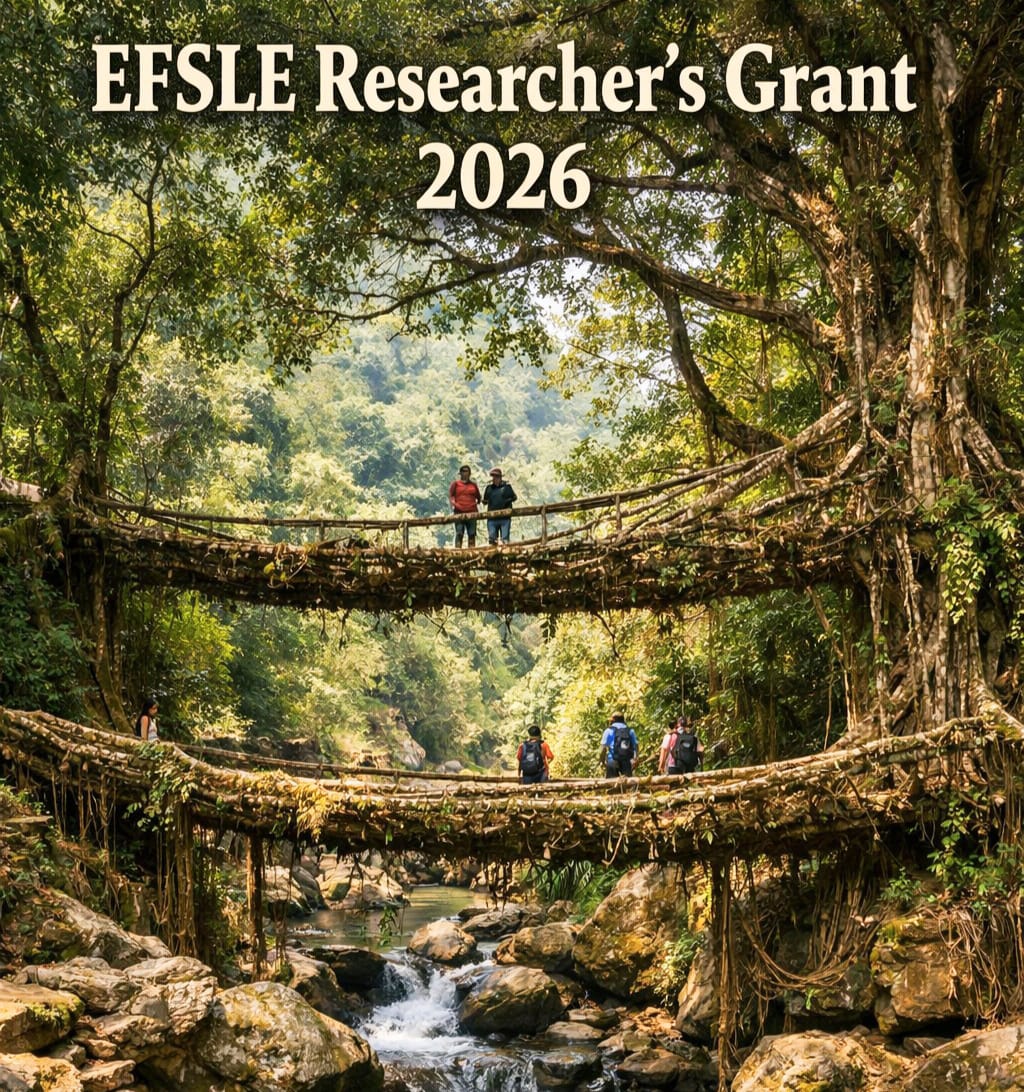
EFSLE Researcher’s Grant 2026
(First ERG’26)
To participate in the 3rd International Conference on Global Plant Humanities
(8–10 May 2026)
NEHU, Shillong, Meghalaya
The Researcher’s Grant 2026:
Ecosophical Foundation for the Study of Literature and Environment (EFSLE) invites the proposals for the panel to participate in the 3rd International Conference on Global Plant Humanities, to be held on 8-10 May 2026 in NEHU, Shillong, Meghalaya, India (North-Eastern Hill University).
This grant is exclusively available to PhD scholars enrolled in recognized academic institutions across India. It is a fully funded opportunity open to researchers from all academic disciplines.
Researcher’s Grant Application Guidelines:
- Only PhD scholars, enrolled in recognized academic institutions across India, are eligible for this grant.
- PhD scholars from all academic disciplines are eligible to apply.
- Total Four (4) grants are available for this conference.
- EFSLE will provide this fellowship to those whose proposals will be selected.
- One panel will be sponsored by EFSLE consisting of 4 participants.
- Proposals for 20-minute papers and 1.5 hour panels (with 4 presenters). For panels with 4 speakers, each presenter will have 20 minutes followed by a Q&A session, if any.
- Email your abstract (max. 300 words) with five relevant keywords along with a bio-note (max. 50 words).
- Please send your proposal to md@efsle.org
- Please mention ‘Plant Humanities Conference-NEHU’ in the subject line.
- The candidates can select any of the themes mentioned below for their proposal.
- The deadline to send the final proposal is 31st of March 2026.
- Conference Registration fee is 2500/- for Indian participants. (The lifetime members of EFSLE, pursuing their PhD, are exempted from any registration fee.)
- All the selected recipients are eligible to avail the total expenses of the return train tickets (the selected candidates can book their tickets themselves in the 3-tier AC coaches only in any train of the shortest route till Guwahati Railway Station. (From Guwahati all the selected participants will be joining the EFSLE team and they will be completing their further journey to NEHU by road). In this case, they will be reimbursed after producing the tickets to be submitted along with the reimbursement form provided by EFSLE during the conference.)
- The grant covers the return train tickets expenses only. However, if any of EFSLE lifetime PhD scholar is selected for the grant, they will be provided the accommodation facility too. Non-member scholars can avail the facility on request paying a minimal amount. Or they can go for their own accommodation arrangements.
- If accommodation is availed, the check-in will be on May 07, 2026 (after 1 PM) and the check-out will be on May 11, 2026 (before 11 AM).
- All the selected grant recipients must present a Valid Identity Card issued by their affiliated institution upon request. Failure to do so will result in the cancellation of their candidature.
- Faculty members who are simultaneously engaged in teaching and pursuing their doctoral research are also eligible to apply for this grant.
Details of the Conference:
Concept Note:
Humanity is profoundly intertwined with the botanical realm. As sources of nourishment, healing, beauty, pleasure, and spiritual experience, plants are vital globally. While making our physical existence possible, floristic life also inspires our identities and expresses our cultural heritage. Populating nearly every corner of the world, plants represent 80–90 percent of the Earth’s biomass. Notwithstanding humanity’s indisputable interdependence with botanical nature, the future of vegetal diversity is uncertain. Habitat degradation, land use changes, and climatic instability will continue to imperil forests, wetlands, grasslands, aquatic ecosystems, and other botanical communities.
In response to global environmental change, the plant humanities (PH) has taken shape as an inter-/ transdisciplinary area of research, pedagogy, and activism concerning plants and their multifaceted transactions with humankind. Entering the public domain in 2018, the term plant humanities refers to “humanistic modes of interpretation” in the study of flora, society, culture, communities, history, art, literature, and other disciplines in the arts, humanities, and social sciences (Batsaki 2021, 2). According to the Dumbarton Oaks Plant Humanities Initiative (2023), plants offer ‘remarkable scope for research and interpretation due to their global mobility and historical significance to human cultures’ (para. 1). The recent turn towards plants in the environmental humanities aims to overcome deep-seated preconceptions of botanical life as insentient, immobile, and inconsequential non-animals.
The burgeoning field critiques dominant cultural narratives of flora as passive and promotes awareness of the significance of vegetal diversity. Scholars draw widely from the related domains of critical plant studies (philosophy), ethnobotany (anthropology), human-plant studies (cultural studies), phytocriticism (literary studies), plant geography, and neurobotany ((plant science). In dialogue with recent empirical advances, plant humanists reevaluate the longstanding presumption that botanical life lacks sentient behavior. The field considers how emerging intersectional understandings of plants can reshape cultural, social, and literary engagements with them. Known by an array of names such as plant neurobiology, the science of plant intelligence examines cognitive processes in flora. This growing area of research points to the presence of altruism, communication, memory, sensing, and other percipient qualities of the botanical world.
Traversing art, science, and imagination, the plant humanities illuminates the material and affective linkages between plants, people, and ecologies. Researchers examine the narratives and ideas connected to flora; the creative works inspired by various species; and the heterogeneous values that embed plants in socioeconomic contexts. The field investigates a broad range of concerns—from climate change and food security to the loss of biodiversity and plant-based cultural heritage. PH calls attention to ethical issues including the social repercussions of genetically modified flora and the moral implications of plant intelligence for cultivation paradigms, even indigenous practices and wisdoms intertwined with the secret life of plants and esoteric beliefs that shape the ecosystems of smaller societies and pastoral communities.
The 3rd International Conference on Global Plant Humanities: Botanical Life in Art, Science, and Imagination at North-Eastern Hill University, Shillong, Meghalaya, India, 8–10 May 2026, will further the conversation between the arts, humanities, social sciences, and natural sciences towards new perspectives on the vegetal world and human-botanical relations. Foregrounding comparative, cross-cultural approaches to studying plants, the conference will highlight advances in plant humanities scholarship globally.
We invite paper and panel proposals including, but not limited to, the following topic areas:
Sub-Themes:
- Art, literature, performance, music, and the botanical world
- Narratives of vegetal agency, sensing, behavior, learning, and cognition
- Narratives of vegetal temporality, memory, and communication
- Plants ethics, aesthetics, and phenomenology
- Botanical conservation, citizen science, arts, and humanities
- Social and cultural implications of scientific advances in plant intelligence
- Gender, sexuality, identity, and flora
- Artistic and design practices engaging plants as partners, collaborators, and agents
- Botanical film, media, and popular culture
- Phytopoetics, phytocriticism, and phytosemiotics
- Plants, posthumanism, and the posthumanities
- Plants, postcolonialism, and globalization
- Spiritualities and theological traditions involving plants
- Plants, nostalgia, solastalgia, mourning, and memorialization
- Interactions between flora, fauna, and fungi in narratives
- Traditional and folk botanical knowledge systems
- Indigenous people’s relations to plants and ecosystems
- Botanical pedagogies addressing issues of ‘plant blindness’ and ‘plant awareness disparity’
- The emergence of the Plant Humanities in the Global South
- South Asian interventions in the field (Bangladesh, Bhutan, India, the Maldives, Nepal, Pakistan, and Sri Lanka).
- Southeast Asian interventions in the field (Brunei, Cambodia, Indonesia, Laos, Malaysia, Myanmar (Burma), the Philippines, Singapore, Thailand, Timor-Leste (East Timor), and Vietnam)
Key Points to be remembered:
Dates of Conference: 8–10 May 2026 (Friday-Sunday)
Theme: Botanical Life in Art, Science, and Imagination
Mode: Offline (For EFSLE Panel)
Host: Department of English, NEHU, Shillong, Meghalaya
Location: North-Eastern Hill University (NEHU), Shillong, Meghalaya
Contacts:
Please direct all inquiries to the following members:
Email: md@efsle.org
Whatsapp: Kumar Paarth, Programme Coordinator, EFSLE – 9953833313
Venue Information:
Established in 1973, North-Eastern Hill University is the oldest central university in the Northeastern region of India which has the objectives to disseminate and advance knowledge by providing instructional and research facilities in such branches of learning as it may deem fit; to pay special attention to the improvement of the social and economic conditions and welfare of the people of the hill areas of the Northeast, and, in particular, their intellectual, academic and cultural advancement. Ensconced in the midst of pine forests spread over an area of about 1100 acres, NEHU has 44 academic departments, with 36 of them located on the Shillong campus and 11 of them on the Tura campus. At present, there are 53 undergraduate colleges affiliated with the University, including 8 professional colleges. The Department of English, established in 1973, is one of the oldest departments of the university with a distinctive history of producing several authors, poets, and critics considered the most eminent in the Northeast of India.
How to reach Shillong: Guwahati is the nearest international airport and railway station to Shillong. There is a domestic airport at Shillong with limited connectivity from select cities. From Guwahati, it is about 2/3 hours to Shillong by road. Taxis and bus services are available from airport and the railway station in Guwahati.